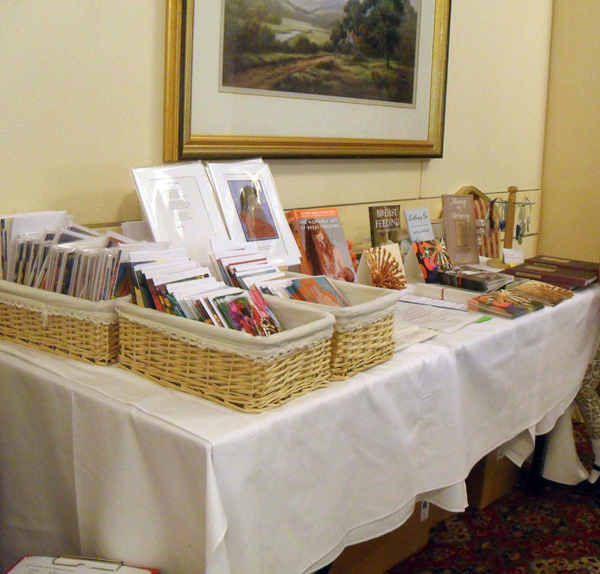
I like the idea of getting dressed up smartly and then going to publishing events, launches, conferences etc. to mix and mingle with the aim of letting the world know about the books and cards I’m producing and selling. The reality though is far different…
There are oh-so-many things to consider now that I am a parent: a breastfeeding little one who, although completely happy with his grandma, likes to check in with his mama from time to time for milk and cuddles; school drop-off and pick-up times for my big girl; a suitable child’s car seat for my mum’s car; enough refreshments, nappies and entertainment to last the day; and the practicality of lugging boxes of heavy books around when trying to hold my little one’s hand AND cross a busy road safely!
So at present ‘events’ don’t fit in easily with family life.
But the annual La Leche League GB conference is, for me, the one big annual event, and I start to think about this months in advance.
Why is this then?
As many of you know, LLL is a charity close to my heart, and their events are, of course, completely child-friendly and mama-friendly. So my little one, grandma in tow, came and went as he pleased – completely fascinated by going up and down the hotel lifts and then exploring the many corridors, then it was back to my stall…
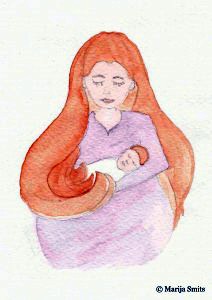
When we had a nappy leak, a friendly mama offered baby wipes which I didn’t have to hand, and my friend, LLL Leader Lois Rowlands (who is also the creator of the image on Letting Go) carried boxes with me and then helped me to find a trolley to transport the rest.
At the end of the second day of the conference my little boy, completely exhausted from all the hotel exploring and excitement fell asleep nursing just as I had to pack away my stall and send my mum off to get her car out of the expensive car park, seconds ticking away… I hadn’t brought a sling with me or anything so knew I would have to ask someone for babysitting help. A friendly Leader offered to sit with both my little ones as I packed up the stall and then ran up and down stairs carrying half-empty boxes, my mum in her car waiting outside.
That’s what I love most about LLL – if you need a hand, a little support when you really could do with some then they are there for you. So this conference will continue to be in my events diary for the foreseeable future. 🙂
And by the way, the mixing and mingling was fun, and it was lovely to hear so many positive comments about my books, cards and prints. I am though looking forward to a rather quieter weekend this weekend… 😉
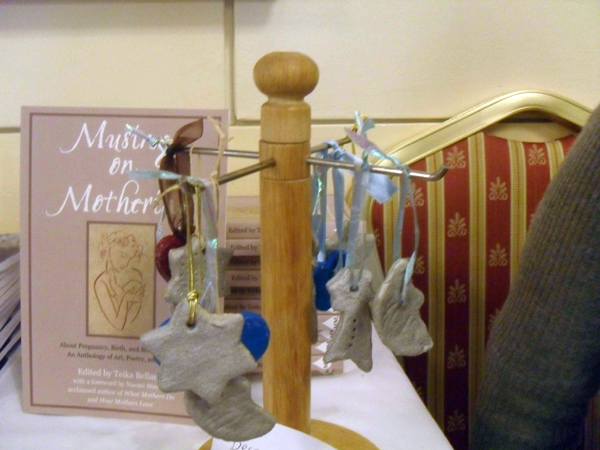
My daughter’s salt dough decorations – she’s a budding entrepreneur too!
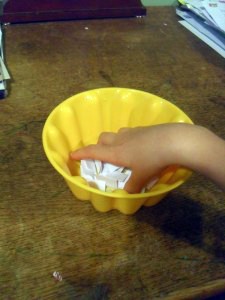
I’m delighted to announce that Ruth Asch is the winner of the autographed copy of Musings on Mothering (she is herself a contributor to the book, so it seems fitting that she now gets to add her own autograph to the book!). On being told the good news Ruth wrote: “WOW!! And I NEVER win things. This must be specially meant to be. How wonderful.” Lyndsey Sporton and Helen Lloyd are runners up (as decided by Lady Luck – in this case, a very eager six-year-old who loves folding bits of paper and swirling them round a pot over and over again with her eyes screwed-up tight).
Thanks to all those who took part and if you’d like to purchase any prints, cards or books, you’ll find some on offer over at THE MOTHER’S MILK BOOKSHOP right now!
Or, if you’re a fan of my giveaways you might like to know that there’s another one happening right now over at Natural Mamas – you can win yourself some lovely mothering greetings cards. Have fun!
Today Musings on Mothering is one year old. So I want to wish it a Happy Birthday! Obviously, this book has been a big part of my life for the past year (and the year before that too) yet I still can’t quite believe that a year has passed since it’s first publication. Here’s a little reminder of some of the great art and poetry within:
I’ve been delighted by all the lovely reviews and greatly appreciated the fact that readers have taken the time to comment on it and recommend it to their friends and family. Royalties from sales of the book, as well the proceeds from the hand bound copy sold for auction via eBay, have now amounted to almost £700. This money has gone directly to the wonderful charity La Leche League GB and I feel this to be quite an achievement for such a tiny press, run mostly during one or two hour slots in the evenings! A big thank you to all who have helped to make this happen, and special thanks go to Barb Sheppard for creating the hand bound copy that sold in the auction.
To celebrate this birthday I am giving away one very special copy of Musings on Mothering. Throughout the past year I have tried to add as many contributor’s signatures as possible to the inside front cover of one of the books. Considering that there are approximately 100 contributors and that they live across the globe this is pretty tough! But by the time the giveaway ends I hope to have the inside cover crammed full as I’m hoping to pick up some more ‘autographs’ at the next LLLGB conference which is taking place on 11th and 12th October 2013.
So, the prizewinner gets the signed copy and two runners-up get a print of their choice from The Mother’s Milk Bookshop and each prizewinner gets ONE free entry to the Mother’s Milk Books Writing Prize. Free shipping – to anywhere in the world – is included in the value of this prize. Many thanks for your interest in this giveaway, and good luck! Musings on Mothering front cover
How to enter:
There are a few different ways to enter. Each method (given that you leave a separate comment for each method completed) will count as a different entry, so the more you do, the more chances you have to win.
– Leave a comment on this post telling me what creative projects you’ve undertaken in the past year. Made a start on knitting something? Taken up watercolour painting? Begun to write your first novel? Created a window of time to do some sewing?
– Tweet the following phrase – Happy Birthday #musingsonmothering! Published by @MothersMilkBks raising funds for #breastfeeding charity @LLLGB http://bit.ly/17bXLxJ – and leave a comment saying you have done so.
– Like Mother’s Milk Books on Facebook, leave a comment saying you have done so.
– Follow @MothersMilkBks on Twitter, leave a comment saying you’ve done so with your Twitter username.
– Follow the Mother’s Milk Books blog by entering your email address in the ‘subscribe’ box, leaving a comment saying you’ve done so.
The competition will close on Wednesday 9th October 2013 at 12.00 noon, GMT.
Terms and conditions:
This competition is open to all.
All correct entries received by this date will be entered into a prize draw and the winner will be chosen randomly.
The winner will be notified on this blog and be contacted within five days.
The winning entries will receive the prize as stated on the blog post. There is no cash alternative, no returns or refunds. Frames for prints are not included as part of the prize.
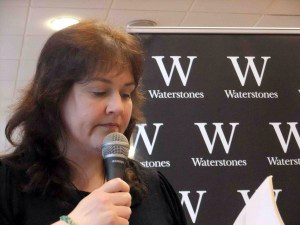
Back in May 2013 I spent a lovely evening at Waterstones in Nottingham listening to Alison Moore read from her new book The Pre-War House and Other Stories. I was enchanted by the way Alison spoke – quietly, but passionately – about where the ideas for her stories originate and the actual process of writing and editing. It was also inspiring to discover that she wrote her Man Booker Prize shortlisted novel The Lighthouse whilst caring for her baby son. This was yet another wonderful example of creativity and motherhood in action! So I was delighted when Alison agreed to the following interview. With many thanks again to Alison for taking the time to answer my questions.
***
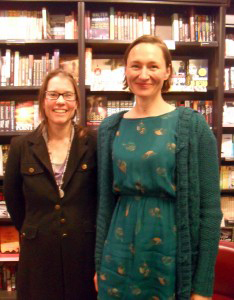
In case you didn’t already know – I’m the short one. 🙂
Alison Moore is the author of The Lighthouse, shortlisted for the Man Booker Prize 2012 and winner of the McKitterick Prize 2013, and The Pre-War House and Other Stories, nominated for the Frank O’Connor International Short Story Award 2013. Born in Manchester in 1971, Alison Moore lives in a village near Nottingham with her husband Dan and son Arthur.
She is a member of Nottingham Writers’ Studio and an honorary lecturer in the School of English at Nottingham University.
1. You began to write at a young age. Were you also passionate about other creative outlets?
I did some drama and youth theatre in my teens, which was fun and taught me a lot, but writing’s always been the main creative area for me.
2. Have you nearly always had some sort of writing project on the go, or have there been some periods in your life which weren’t as productive?
It was very sporadic when I was younger, although I’ve always tended to jot things down. Even when I was in my thirties, before having my son, I’d be working full-time and doing voluntary work and evening classes and not necessarily writing until a story came along and needed writing.
3. You must inevitably have had to deal with rejections of your work at various times. In an earlier interview on this blog, Cathy Bryant said to ‘Expect rejections, and throw a party when you’ve had a 100.’ Did you ever come close to throwing a party?!
I’ve had a whole bunch of stories creeping back home with their tails between their legs. I’m not sure they’d be in the mood for a welcome-home party but you do just have to get on with it. If you’re getting rejections it means you’re writing and sending work out so that’s a good starting place. Hopefully enough will find a home to keep you going, and the ones that come back you have to look at with a critical eye.
4. As I understand your Booker shortlisted novel The Lighthouse was written when your son was very little. How did you manage to fit in writing whilst caring for a baby?
I started writing The Lighthouse when my son was about six months old, but it only worked because I didn’t really do both things at once. I only wrote when he was asleep – sometimes typing one handed on my laptop while he was napping on me after a feed – or when he was out with his dad or his grandma. So it was a bit ad hoc but it got done and I thoroughly enjoyed it!
5. Can you think of some really positive things about fitting in writing with everyday motherly work (or household chores!)?
Having got into the routine of writing every day, the story was always in my head. I wasn’t consciously thinking about it while I was playing with my son or talking to him while I emptied the dishwasher, but in downtimes it was all there ready to go – I’d get a bit of story or the solution to a problem when I was in the shower or sitting in the dark feeding him at night.
6. Would you say that motherhood has enhanced your creativity or simply changed it in some way?
What it did is put a stop to the routine I was in where I did a whole lot of things in my free time but none of them was writing every day, and I started again, so even though I had a lot less free time after having a baby, what I did have I used for writing.
7. In some of your writing the absent mother is one of the most haunting characters. Can you tell us more about that?
The majority of my stories – and all those in my collection – have been written since losing my mother, so that’s presumably where this recurrently absent figure comes from but it’s quite a shock for me to see the stories collected and to realise just how often the mother, for all sorts of reasons, just isn’t there.
8. What are you working on right now and when’s your next author event?
I’ve been working on my second novel, which is about ready to be delivered up for inspection. My editor Nicholas Royle and my husband Dan will be the first to read it.
On Saturday 28 September I’m doing an event at Marlborough Literature Festival in relation to receiving this year’s McKitterick Prize for The Lighthouse, and on Sunday 29 September I’ll be at the short story festival Small Wonder with Brian Kimberling. www.alison-moore.com/events
9. Do you consider yourself a ‘full-time writer’ now that your son is at school?
I do. His school is a few minutes’ walk away so after taking him there I have six hours before going to pick him up, so if I get a bit done in the evening too I’m writing or doing writing-related work full time now.
10. Is there any one person (or persons) that you consider to be a true inspiration to you?
When I think of being inspired to write, wanting to write, I picture being a child, sitting on the edge of my bed with a book in my hands and more on my shelves, my typewriter on my dressing table. I tend to think every story I’ve ever read must inspire or influence me to some degree.
11. What would you say to someone who doesn’t particularly see themselves as a creative person but who would like to try to make a go of writing?
It might depend on how you think about creativity. Writing doesn’t always feel so creative to me; sometimes it feels like just organising what’s hanging around in my head, but it creates something.
Two exciting things are happening in Mother’s Milk Books right now: we are about to publish Angela Topping’s poetry collection Letting Go (estimated publication date is 6th September) and the Mother’s Milk Books Writing Prize has also just now been launched (with Angela herself doing some of the judging, along with Susan Last of the independent press Lonely Scribe). So I’m all aflutter at the moment!
Letting Go is available for pre-order right now at the discounted price of £6.99 from THE MOTHER’S MILK BOOKSHOP and it will continue to be available at this price for the next week or so. Do stop by and take a look – we’ve had some great reviews of it already from well-known poets. And remember, for every purchase made at our online shop (or via the postal Order form for all items – UK delivery or directly from me) you get one entry to the writing prize. So if any of the writing from Musings on Mothering, or Letting Go inspires you in any way to get writing – poetry or prose – why not put pen to paper and enter the competition? There’s even a free-to-enter poetry competition for children. So let the writing commence!
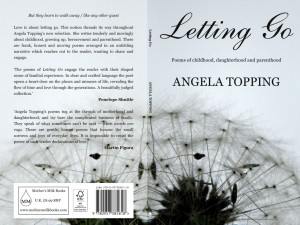
Here are the words from the back cover of Letting Go (that’s if you need any more persuasion from me to buy a copy of Angela’s great new book!):
Love is about letting go. This notion threads its way throughout Angela Topping’s new selection. She writes tenderly and movingly about childhood, growing up, bereavement and parenthood. These are frank, honest and moving poems arranged in an unfolding narrative which reaches out to the reader, wanting to share and engage.
‘The poems of Letting Go engage the reader with their shaped sense of familial experience. In clear and crafted language the poet opens a heart-door on the pluses and minuses of life, revealing the flow of time and love through the generations. A beautifully judged collection.’
Penelope Shuttle
‘Angela Topping’s poems tug at the threads of motherhood and daughterhood, and lay bare the complicated business of family. They speak of what sometimes can’t be said — when words are rags. These are gentle, honest poems that honour the small sorrows and joys of everyday lives. It is impossible to resist the power of such tender declarations of love.’
I’m delighted to be taking part in the Story of Mum virtual tour on the theme of motherhood and identity. Here is what I came up with… Enjoy!
Motherhood and Identity
by Teika Bellamy Oh, where to start?
I think I could probably write a whole book on ‘motherhood and identity’, but this being a blog post where I don’t want to bore your socks off, I will keep it short (well, I’ll try!).
What motherhood and identity means to each individual mother will be unique to that woman, and what I love about Story of Mum is that it has inspired so many mothers to reflect on this:
‘I’m a mum and a ___________ ’
and to then add her own words to that fragment to make the sentence whole, and unique to her.
I added my own words to that a while back, and you can read about it here in ‘I’m a mum and a book birther.’
I’m about to birth another book soon, so of course I’m still a book birther, but when I gave it more thought, I realized that although ‘birther’ is a noun, it is really perceived to be more about ‘doing something’ (in physical terms) rather than metaphysical terms.
So much of mothering, and identity, is about what we DO. Yet that really only is the tip of the iceberg. All too often a mother’s busyness is mistaken for an inactive, passive mind. And yet there might actually be a huge amount of thinking and reflecting going on in those little grey cells of hers…
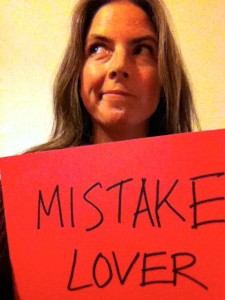
I’ve been reading the ‘I’m a mum and a ___________’ articles with great interest; each mother’s complete sentence holds its own fascinating story, but for this post I was inspired by the following words and image as created by Pippa, who is the creative, mama-driving force behind Story of Mum:
For how human it is to make mistakes! (and super-human to admit to them). Yet mothers, in particular, are incredibly hard on themselves. I’m sure that all mothers worry about ‘doing things wrong’ but it’s probably not helped by a society where guilt is an ever-present subconscious human companion — particularly for women who have more of an innate empathic sense of the needs of those around them, and a desire to meet those needs.
And yet how much support do mothers get? It is often said that it takes ‘a village to raise a child’ yet in today’s world we often don’t even know who our neighbours are. So many mothers are doing the intense and time-consuming work of raising a child with little, or no support. Thank goodness for friendly and non-judgemental mother-networks, whether they be in real life or online. Thank goodness for Pippa, and places like Story of Mum (and the NCT, ABM, La Leche League GB…) where a mum can share her worries and doubts, and feel supported by others who have been there and come through the other end.
Old-fashioned it may be, but I like to think of myself as a philosopher (to be precise I think of myself as a philosopher-poet!) for since I became a mother, I don’t think I’ve ever done as much thinking, or reflecting as ever before in my life.
“Because philosophy arises from awe, a philosopher is bound in his way to be a lover of myths and poetic fables. Poets and philosophers are alike in being big with wonder.” St Thomas Aquinas
Since becoming a mother I have certainly been ‘big with wonder’ – I am in awe of my children who love with such innocence and intensity. I am in awe of their great capacity for forgiving their parents – particularly when their parents have enough honesty to say ‘I’m sorry, I made a mistake.’ (And oh yes, I’ve been there, and received the biggest hugs ever when I’ve apologized to my children for making a mistake.)
I am in awe of my children’s ability to really see things, to be alive to the moment; to not have any fear when trying their hand at creative stuff – unimpeded by ‘I can’t do this’ or ‘I’m no good at this’ type of pre-conceived ideas we have as adults. I love that my daughter can instantly paint a picture of me, without hesitation or restraint, whereas I struggle to paint a picture of her because I am fearful of making a mistake; of it not being ‘good enough’.
As well as all this, I am also in awe of the great power contained in mothers’ bodies — for the ability to conceive and bear a child, to go through the marathon-like work of labour, and then to produce milk that is unique – and perfect – for their child IS pretty amazing. And then to summon the energy to do a 24-hour job day after day after day (sometimes on little or no sleep!) and still have a heart full of love and patience to keep going is pretty amazing.
So whichever word (or words) that a mother chooses to add to: ‘I’m a mother and a ___________’
the words ‘and amazing’ really should be added as a postscript.
Some reflections on the birth of a mother, and what it means to be a mother… by Teika Bellamy
The other day (22/07/2013) my mum called me late in the evening and left a message on my answerphone, “a boy has been born…”. Now I admit I’m not the most news-aware person in the world but even I knew what she was talking about. (My mum, bless her generous heart, is a big fan of the Royals and gifted the Duchess of Cambridge with a copy of Musings on Mothering a while back, but that’s another story…!)
Anyway, I was glad to hear that the Duchess of Cambridge’s son had safely arrived in the world, and as I went to bed that night I couldn’t help but wonder how the new mother (indeed, every new-born mother) was feeling. I looked back to the night, about six years ago, when I gave birth to my own first baby and the strong emotions I experienced after the birth.
I was in hospital and recovering from a post-partum haemorrhage and second-degree tear to my perineum. I was sore but happy; hungry and tired. It was good to have my husband around; it was good to finally meet my baby and hold her in my arms.
The first time I put my daughter to my breast I felt as though I had reached the culmination of womanhood; my womb and placenta had provided for her for the first nine months of her being, now my breasts and arms would continue to keep her well fed and safe.
However, when my husband had to leave the hospital, and it was just my daughter and I together, I couldn’t help but feel a little worried. It was just the two of us now – would we be okay?
I put her in the bedside crib for a moment, bundled in her NHS blanket, and I lay back in my bed and closed my eyes. I wasn’t really expecting to sleep – the lights were still on and there was a lot of background noise in this strange, clinical place, but I was tired. I must have dozed a little, because I very clearly remember being jolted awake and immediately, instinctively, looking to my baby. She appeared to be completely still, not breathing, and my heart almost burst with fear. My hands flew to her chest to find her heartbeat, to make sure that her chest was still moving up and down, and when I knew that she was okay – simply asleep and peaceful – I cried. This was the moment I really knew what it was to be a mother: for the rest of my life I would know joy, pure, wonderful joy in being a mother to my children, but also the fear, the very primal fear of knowing that something might happen to them.
Mothers throughout the world live with these two powerful emotions every day. We long to make sure that our children are well fed and safe, and sometimes, in the early days our fears for their safety may seem overwhelming. Certainly, our anxieties about them being well fed are common, particularly in the west. It can be of great solace to a breastfeeding mother to meet with other breastfeeding mothers to discuss weight gain concerns in the early days. Speaking with a counsellor from a breastfeeding support charity like La Leche League can be invaluable too, especially for a mother who needs some reassurance and good information about how often to feed in the early days and weeks.
I still remember how it took many months, years even, for my fear for my daughter’s safety to ease off. Even now, I like to go to my children’s beds and stroke their heads when they’re fast asleep. It’s an extra way for me to re-connect with them – to again check that they’re okay – when we’ve been extra busy during the day.
Obviously, as our children get older our fears for their safety lessen, although of course they can be replaced by other, new and perhaps more complicated fears.
Just the other day, I lost sight of both my children in the school playground. I thought perhaps they’d walked home together already (we only live about a minute’s walk away from the school) so I rushed out of the school gates and down the road to find them… but they weren’t there. I ran back to the school (ultra-aware that I was the only parent there without a child – my heart almost bursting with fear again) and then I spotted them. Tears came to my eyes as relief at finding them washed over me.
This is the mother-burden: the fear that allies itself with joy, and no amount of money, possessions or status can remove it from a mother’s heart. Yet this is what it is to be human: to know our own mortality. Sometimes our fears are irrational, sometimes they are very real and rational; they are nearly always a useful way to connect with our inner voice, which can swiftly impel us to make necessary adjustments to our everyday lives so that fear can be avoided for future scenarios.
It would certainly be less of a burden to not feel fear for and on our children’s behalf, yet let us not forget that fear is a powerful – and sometimes urgent – reminder of how much we love and value our children. And I firmly believe that our ability to love unconditionally is our strength.
As it’s Fathers’ Day I’m publishing a dad’s perspective on mothering in today’s post. This article was first published in the La Leche League Members’ magazine Breastfeeding Matters (May/June 2013 issue) and although I’m biased (it’s by a certain Tom Bellamy!) I hope you’ll agree it’s worth taking a few minutes out of your day to read.
Mums Can’t Win
by Tom Bellamy
Becoming a father for the first time creates a whole raft of new emotions and experiences and ideas, but for me there has been one realization that is more depressing than the sleepless nights, toddler tantrums, or soiled nappies, and it’s this: Mums can’t win.
I have to admit, before the birth of my daughter, I had given very little thought to the manner in which children should be raised. Beyond a vague sense that breastfeeding is obviously better than a bottle – you know, for a few months or so; perhaps till they have teeth? – I had no strong opinions about issues such as sleep training, babywearing or cloth nappies. After the birth of my daughter, I very quickly realized that the rest of the world has very strong opinions.
My wife and I made some plans before the birth: decorating a nursery, and borrowing a Moses basket, and generally going through the naïve motions of parents that expected their child to meet their expectations. And then our daughter arrived and showed us what we were doing wrong. She wouldn’t sleep in her cot. No matter how many nights of cajoling, soothing, and strategizing we attempted (I even had a plan on a clipboard at one point), she just refused. I remember a turning point when, exhausted and upset, my wife and daughter fell asleep together while breastfeeding, and we all slept until morning. The next day, I took our bed apart, wrestled the divan into the garage, laid the mattress on the floor, made it safe for co-sleeping, and we haven’t looked back. To make it clear: this was never my plan, but we were willing to adapt to our daughter’s needs, and the benefits of getting her to sleep alone did not seem important enough to force her to do it. We knew other families who made the opposite choice, and sleep-trained through cry-it-out, just as a GP had advised us. It worked for them, but it didn’t work for us, and that was the point at which I realized that Mums can’t win. No matter what choice they make, other people won’t respect it.
It strikes me now that there is literally no set of choices that a mother can make which will receive universal praise, or even acceptance. For every mother that chooses to breastfeed, there are others calling them the “breastapo”. For every mother that chooses to bottle feed, there are health professionals chiding them (but offering curiously little breastfeeding support). For every mother struggling with sleepless nights, there are friends and family full of bright ideas that worked for them. The saddest thing, though – the most pernicious problem – is that politely declining the advice is taken by the contributor as a criticism of their own choices.
“I let mine cry it out, and after a few days everything was fine.”
“I don’t think that will work for us…”
“Well I’m only trying to help! You’re making a rod for your own back!”
As a Dad, I seem strangely blameless for the choices we make as a family in the eyes of the wider world, and so my wife takes all the heat of criticism and condescension when people discover we’ve done things differently from them. I guess parenting is like religion and politics – best avoided in polite conversation – but it does seem a shame that parents can’t be more cooperative and less competitive. Maybe then, by supporting each other more, and ignoring the opinions of the opinionated, Mums can help each other win their own personal battles.
The next interview in the Mother’s Milk Books series of guest posts about creativity features the truly gifted Cathy Bryant, who contributed to Musings on Mothering. I greatly admire Cathy’s determination. To go from dreaming “of being able to write well enough” to international recognition for her writing and a whole host of publications is quite a feat. She’s certainly an inspiration to me. Thank you Cathy for taking part.
***
Cathy Bryant lives in Manchester, UK. Her first award came in 2010 with the Marple Humorous Poetry Prize. She won the 2012 Bulwer-Lytton Fiction Prize for the worst opening line of a novel, and is a former blogger for the Huffington Post. Her stories and poems have been published on five continents, so her ambition is to break into the Antarctican market. Also in 2012, Cathy won the Sampad ‘Inspired by Tagore’ Contest, one of the Malahat Review Monostich Contests and the Swanezine Poetry Contest. In 2013 Cathy won the M.R. Jordan Writing Contest. She co-edits the annual anthology ‘Best of Manchester Poets’ and her collection, ‘Contains Strong Language and Scenes of a Sexual Nature’ was published recently. See more at: www.cathybryant.co.uk
1. Have you always considered yourself to be a creative person?
I wanted to be creative, but I didn’t think that I had any talent. But I read so hungrily and tried to write, and dreamed of being able to write well enough to be published. I just didn’t think it would ever happen.
2. Has there been any life-changing event that enhanced your creativity? If yes, can you tell us more about it?
Yes, and for me it was all about confidence. I’ve always been very lucky in my friendships, and one day my best friend Neil Bundy changed my life for me.
On 1st January 2007 I asked if he had any resolutions.
“Yes,” he said. “My New Year’s Resolution is for you to get your poems and stories published, and if you don’t even try then my year will be a failure, and it’ll be your fault!”
I laughed a bit nervously, but he looked at me and said, “I’m dead serious. That’s what I want this year. I want you to send your work off to magazines and things.”
Well, I was furious at such blackmail. And I knew that no one would want to publish my stuff. So I sent off half a dozen different pieces to various magazines and anthologies, just to prove to him that no one would want them, and got rejections. And then two acceptances…. one to an Australian magazine that sent me a free copy and paid me actual cash! Could it be that I had a touch of real talent, and that my writing wasn’t a selfish indulgence? Maybe I should let myself do it a bit more?!
After that I let myself be much more creative. A little confidence goes a long way! And Neil is the best friend in the world!
3. Do you have any tips on how to find time for your creative work amongst the everyday busyness?
Yes, absolutely – prioritise it. People tend to sideline creativity as if it isn’t necessary – like exercise they’ll try to fit it in with “more important” things like drudgery… I recommend setting aside a time each day (or each week, if you’re really time-poor) for writing, and keeping to it unless there’s a fire or similar emergency. The dishes in the sink will wait. No one died wishing that they had been more prompt with the washing up. And it’s setting an excellent example to your children to show them that even a grown-up is allowed a little of their own time in which to play and create. Even if it’s only fifteen minutes. You can write a lot in fifteen minutes!
4. What does breastfeeding mean to you?
Not being a mother, I hadn’t thought about it much until I worked with children. I sort of fell into childcare when my sister had premature twins (who are now grown-up – one is married and an actuary, and the other is a biologist – yet I used to carry them both with one hand in a tiny carrycot!) and I helped her with them, as her husband had to work away a lot. From there I dived into the happy world of childcare, and came into contact with breastfeeding – and the strange attitudes towards it.
I’d always assumed that breastfeeding would be welcomed and celebrated everywhere – I mean, what’s more natural or important? So when I was with feeding mothers, and strangers would be disapproving, unhelpful or even hostile, I was horrified. There also seemed to be a prevalent idea that breastfeeding stops very early, which seemed odd and arbitrary to me – and possibly just another case of hostility towards women. Yet some people said that babies shouldn’t be breastfed after four months, or six months, or whatever. It made me angry, when it was so obvious that breastfeeding was a beautiful thing that helped both mother and child and was the summit of both love and practicality.
When I heard about Musings on Mothering I didn’t think that I should submit anything, not being a mother – but the poems kept coming, particularly those based on my conversations with other child abuse survivors and their experience of motherhood. I asked some fellow writers who are mothers what they thought, and they said, go ahead! Supportive non-mothers are definitely part of the picture!
5. Were there any pieces in Musings on Mothering that spoke to you particularly?
Loads of them. Too many to mention. The quality of the content is breathtaking. I will say, though, that Angela Topping’s work always strikes a chord with me. She can touch the deep places and yet does it without any fanfare or pretension – after reading her poems I always feel moved and enlightened.
6. Are you working on any particular project right now?
Oh yes – I’m always messing about with something. I wrote a very rough first draft of a novel during National Novel Writing Month in November 2012, and it’s currently getting its second full edit. It’ll probably need at least one more full edit and then it’ll be off to start collecting rejections – and maybe an acceptance, as Neil would remind me! I’ve also just finished putting my second poetry collection together (PLUG ALERT: My first collection is available here, at Amazon) and a book of genre short stories – fantasy, science fiction and horror, with a dash of comedy thrown in. So now all I have is the easy task of finding a good publisher for each of them… oh for that magic wand…
7. Is there any one piece of work that you are particularly proud of?
I’m horribly proud of everything. It’s still all so surprising to have work published and to perform my pieces, and have people laugh and applaud rather than throwing things and leaving. I’m like a child with a birthday cake whenever I get an acceptance.
Winning the Bulwer-Lytton Fiction Contest in 2012 was wonderful – I gave loads of interviews and was mentioned in the international press! I received a fair bit of fanmail too, which is always lovely.
One stand-out memory is of performing in Waterstones recently. I’d had a poem published in an anthology called She’s the One, a celebration of personal heroines. So many ‘50 Great Women’-type books tend to be celebrity lists, whereas this was a book in which people wrote poems, stories and memoirs about those who really meant something to them, whether that person was a war heroine or their sister. I was thrilled to be in it, and performing at Waterstones for the launch was a dream come true. If you’d gone to me just ten years ago and said, “In ten years time you’ll have a book out, be published in hundreds more and be a veteran performer,” I’d have thought it was a cruel joke.
8. Is there any one person (or persons) that you consider to be a true inspiration to you?
Again, too many to mention, but here’s one very special one. Dominic Berry, the performance poet, used to run cheap (or free to those who couldn’t afford it) writing workshops which were both friendly and helpful. He taught me how to appraise a poem in a constructive way – “How attached are you to that ‘and’?” I remember him asking once, and I realised that after one’s burst of creation, one really has to look at every bit of a piece of writing to see what works and what doesn’t. He’s also the king of performance poetry and very friendly and supportive of other performers, and he gave me my first performance gig (and I do over-use the word ‘and’). With his talent it would have been easy for him to concentrate purely on his own career, but he has injected energy, commitment and love into the Manchester poetry scene, and he’s an all-round good guy. He showed me and taught me so much, and never asked for any return. I recommend heartily any book or performance of his – he’s converted many a dubious person to the delights of the written and spoken word.
9. Is there any one piece of art or music, or writing that has influenced you, or inspired you to continue creating?
The writing of Tanith Lee for prose and Sylvia Plath for poetry. Those are the two I keep coming back to, who seem to have a hotline to my inner self and can charge and inspire me any moment.
10. What would you to say to someone who doesn’t consider themselves a creative person, but would like to try their hand at something new?
Oh, have a go! Why not? And (there I go again with ‘and’…) let yourself write crappy first drafts – don’t paralyze yourself trying to write a bestselling classic from the word go. Don’t worry too much about quality at first – just do some writing exercises and write anything you fancy. The more different things you try, the more you’ll find what works for you and what doesn’t. Then join a local writing group. Be polite to everyone, but you’ll soon find out whose feedback is worthwhile and constructive, and you can learn an awful lot. If you’re a poet, try an open mike night or two. And whatever you write, when you have about ten pieces, send them all off to different magazines or anthologies and see what happens. Proofread them carefully and always read and follow the submission guidelines, and you stand as good a chance as anyone. Expect rejections, and throw a party when you’ve had 100. Incidentally, on the first day of every month I post a list of calls for submission and writing competitions, all free and with easy, electronic entry here: https://www.facebook.com/pages/Write-Out-Loud-Community/260122457345775?fref=ts – so do have a look and a go. (Please note: Cathy now has an excellent website where she posts many free-to-enter competitions and submissions calls: Cathy’s Comps and Calls.)
And always enjoy yourself. If ever it starts to feel a bind, then take a break and remember why you wanted to have a go in the first place – play with words and have fun!
Many thanks to all those who entered the giveaway and spread the word about the competition and Mother’s Milk Books.
The winning entry – as pulled out of a hat by my six-year-old daughter – is from Lisa Hassan Scott.
When I contacted her to tell her she was the winner she said – and I quote “Yippee!”. So I think she’s pleased 😉
I’ll be posting out her goodies soon.
Don’t forget that these goodies are available to buy from THE MOTHER’S MILK BOOKSHOP and they’re on special offer at the moment. Have a browse, see if there’s anything you like, and feel free to email me on: sales [at] mothersmilkbooks.com if you have any questions. Many thanks and enjoy the rest of your Bank Holiday weekend.